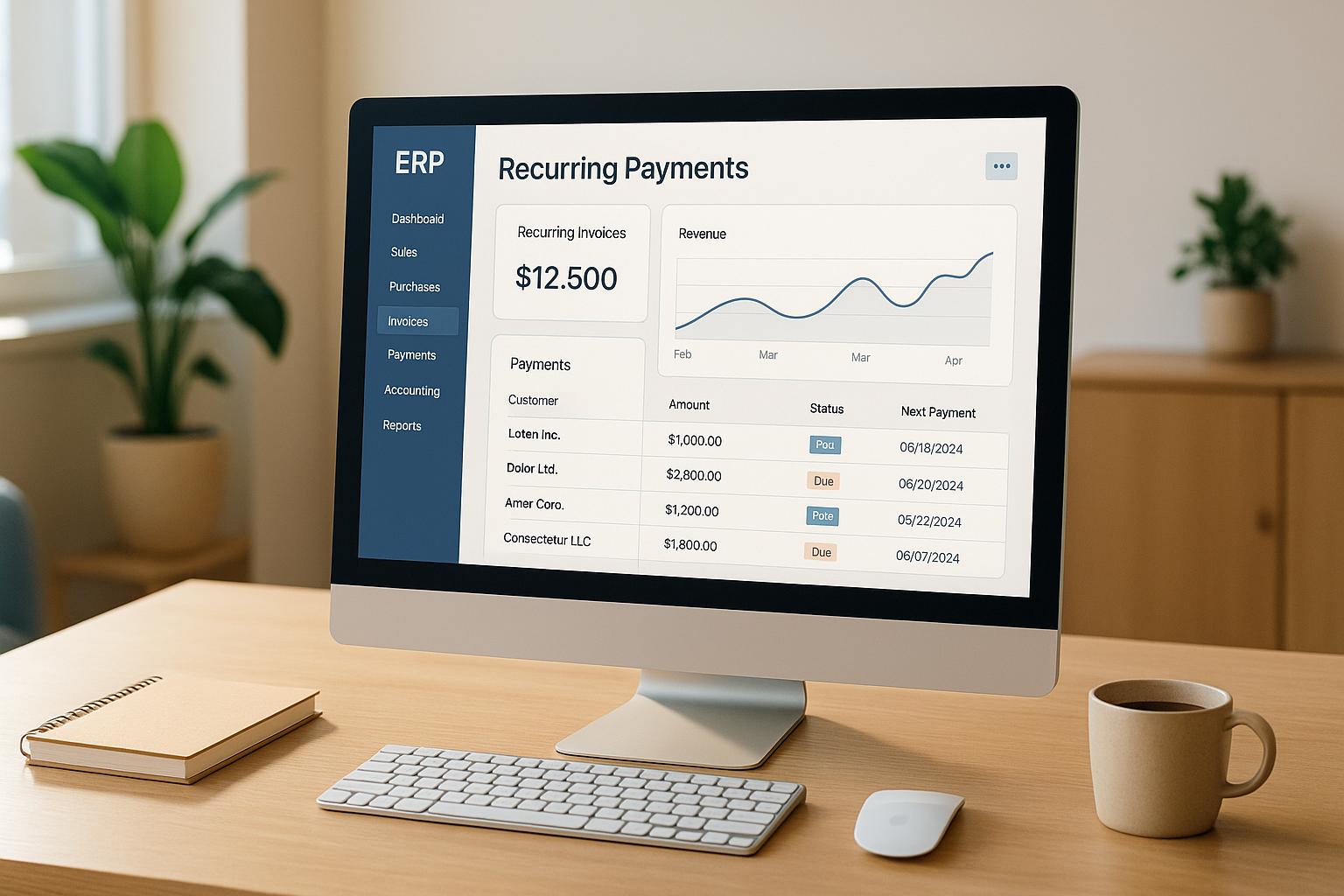
<p>Recurring payments are vital for UAE businesses, especially those in SaaS, consulting, and subscription-based services. Managing these payments manually can lead to inefficiencies, late payments, and VAT compliance challenges. ERP systems simplify this by automating invoicing, reconciliation, and compliance, ensuring smoother operations and better cash flow.</p>
<p>Here’s a quick look at the top ERP options for managing recurring payments in the UAE:</p>
<ul>
<li>
<a href="https://www.odoo.com/" target="_blank" rel="nofollow noopener noreferrer" style="display: inline;"><strong>Odoo</strong></a>: Affordable and customizable for SMBs, with strong VAT compliance and local payment gateway integrations.
</li>
<li>
<a href="https://www.zoho.com/ae/books/what-is-zoho-books/" target="_blank" rel="nofollow noopener noreferrer" style="display: inline;"><strong>Zoho Books</strong></a><strong>/</strong><a href="https://www.zoho.com/one/" target="_blank" rel="nofollow noopener noreferrer" style="display: inline;"><strong>Zoho One</strong></a>: Simple to use, with automated billing and Arabic language support, ideal for smaller businesses.
</li>
<li>
<a href="https://quickbooks.intuit.com/online/" target="_blank" rel="nofollow noopener noreferrer" style="display: inline;"><strong>QuickBooks Online</strong></a>: User-friendly with strong multi-currency support, widely adopted by UAE SMBs.
</li>
<li>
<a href="https://www.microsoft.com/en-us/dynamics-365" target="_blank" rel="nofollow noopener noreferrer" style="display: inline;"><strong>Microsoft Dynamics 365</strong></a>: Best for larger SMBs with complex billing needs, offering advanced features and scalability.
</li>
<li>
<a href="https://www.workday.com/" target="_blank" rel="nofollow noopener noreferrer" style="display: inline;"><strong>Workday</strong></a>: Premium solution for mid-sized businesses managing intricate subscription models and financial reporting.
</li>
</ul>
<p>Each system has its strengths and limitations, so choosing the right one depends on your business size, billing complexity, and growth plans. Automation tools can further enhance ERP systems by reducing manual tasks and improving customer payment experiences.</p>
<h2 id="build-and-automate-subscription-business-with-odoo-erp-manage-bill-and-grow-or-viral-youtubevideo" tabindex="-1" class="sb h2-sbb-cls">🔁 Build & Automate Subscription Business with Odoo ERP - Manage, Bill & Grow | #viral #YoutubeVideo</h2>
<iframe class="sb-iframe" src="https://www.youtube.com/embed/YMOVoPfruw4" frameborder="0" loading="lazy" allowfullscreen style="width: 100%; height: auto; aspect-ratio: 16/9;"></iframe><h2 id="why-erp-integration-matters-for-recurring-payments" tabindex="-1" class="sb h2-sbb-cls">Why ERP Integration Matters for Recurring Payments</h2>
<p>Integrating an ERP system with your payment processes can transform how businesses handle recurring payments. By automatically transferring invoice data and matching payments, it eliminates the need for manual data entry, cutting down on errors and ensuring invoices are processed consistently.</p>
<p>One major benefit is <strong>automated invoicing</strong>, which ensures invoices are generated and sent on time. This not only improves cash flow predictability but also reduces the likelihood of late payments. For example, a consulting firm in the UAE implemented Microsoft Dynamics 365 integrated with a payment gateway. As a result, they automated their monthly retainer invoicing and payment collections, slashing manual reconciliation time by 70% and cutting late payments by 30%. This real-world example highlights how ERP integration can streamline recurring payments.</p>
<p>Another advantage is <strong>real-time reporting</strong>. With immediate access to data on recurring revenue, outstanding invoices, and payment statuses, businesses can make better decisions and forecast cash flow more accurately. Advanced ERP platforms, like Microsoft Dynamics 365, even leverage AI to predict cash flow trends and flag potential payment issues before they escalate.</p>
<p>ERP integration also makes life easier for customers by enabling multiple payment options. This reduces friction during the payment process, encouraging faster settlements and improving overall cash flow. Additionally, it automates tax calculations, maintains audit trails, and simplifies VAT and e-invoicing compliance - addressing common challenges like manual reconciliation and regulatory requirements.</p>
<p>For businesses handling marketplace or multi-party transactions, integrated ERPs can even split payments automatically, streamlining complex operations.</p>
<p>What’s more, plug-and-play ERP integrations are particularly beneficial for small and medium-sized businesses (SMBs) in the UAE and GCC regions. These systems minimise IT complexity and speed up deployment, allowing SMBs to automate recurring payment workflows without needing extensive technical expertise.</p>
<p>Studies show that automating payment and invoicing processes can cut manual workloads by as much as 70% and reduce payment delays by 30–50% for SMBs. These efficiencies lead to better cash flow management and lower administrative costs, making ERP integration a smart, forward-thinking investment rather than just a tech upgrade.</p>
<h2 id="1-odoo" tabindex="-1" class="sb h2-sbb-cls">1. Odoo</h2>
<p>Odoo is an open-source ERP platform that’s particularly well-suited for UAE small and medium-sized businesses (SMBs) looking to automate recurring payments. Its popularity in the Middle East stems from its ability to deliver extensive features without the hefty price tag of enterprise-level systems. Let’s dive into what makes Odoo stand out, especially in terms of handling recurring billing.</p>
<h3 id="recurring-billing-features" tabindex="-1">Recurring Billing Features</h3>
<p>Odoo’s <strong>Subscriptions</strong> module is a game-changer for managing recurring billing. It handles everything from straightforward retainers to complex subscription plans. The system automatically generates invoices based on schedules you define - whether weekly, monthly, quarterly, or annually. It even accommodates <strong>pro-rata billing</strong> and <strong>mid-cycle adjustments</strong>, which is a lifesaver for service-based businesses that frequently tweak client packages.</p>
<p>The platform also automates subscription renewals and tracks important metrics like monthly recurring revenue (MRR). On top of that, it sends escalating payment reminders, reducing the need for manual follow-ups. For businesses offering tiered services, Odoo supports <strong>usage-based billing</strong>, enabling dynamic adjustments based on how much customers actually use.</p>
<h3 id="integration-with-payment-gateways" tabindex="-1">Integration with Payment Gateways</h3>
<p>Odoo integrates seamlessly with a range of payment providers, including UAE favourites like <a href="https://www.network.ae/en" target="_blank" rel="nofollow noopener noreferrer" style="display: inline;"><strong>Network International</strong></a>, <a href="https://www.checkout.com/" target="_blank" rel="nofollow noopener noreferrer" style="display: inline;"><strong>Checkout.com</strong></a>, and <a href="https://site.paytabs.com/en/merchant-dashboard-and-app/" target="_blank" rel="nofollow noopener noreferrer" style="display: inline;"><strong>PayTabs</strong></a>. It also works with global gateways such as <a href="https://stripe.com/ae" target="_blank" rel="nofollow noopener noreferrer" style="display: inline;">Stripe</a>, <a href="https://www.paypal.com/" target="_blank" rel="nofollow noopener noreferrer" style="display: inline;">PayPal</a>, and <a href="https://www.adyen.com/en_AE" target="_blank" rel="nofollow noopener noreferrer" style="display: inline;">Adyen</a>, making it a versatile choice for businesses serving both local and international markets.</p>
<p>The platform simplifies payments by generating secure, branded links that support multiple payment methods. It also handles multi-currency transactions with real-time currency conversion, ensuring smooth operations for businesses dealing with global clients. These payment integrations, combined with its localised features, make Odoo a strong fit for the UAE market.</p>
<h3 id="uae-market-relevance" tabindex="-1">UAE Market Relevance</h3>
<p>Odoo has carved out a niche in the UAE, thanks to its localised features and support. Local implementation partners provide Arabic language options and region-specific customisations, ensuring businesses can meet UAE-specific operational and compliance needs.</p>
<p>One of its standout features is <strong>VAT compliance</strong>, which aligns perfectly with the UAE Federal Tax Authority’s requirements. Odoo automatically calculates the 5% VAT on applicable transactions and generates tax-compliant reports. It’s also ready for <strong>e-invoicing</strong>, helping businesses keep up with digital invoice mandates. Additionally, its document management tools ensure proper archiving of invoices and payment records, which is essential for audits.</p>
<p>Another key advantage is its <strong>multi-language interface</strong>, offering both English and Arabic, which is crucial for catering to the UAE’s diverse client base.</p>
<h3 id="scalability-for-smbs" tabindex="-1">Scalability for SMBs</h3>
<p>Odoo’s modular design allows businesses to start small - focusing on essential modules like Accounting and Sales - and expand as their needs grow. Additional modules like Inventory, Manufacturing, or Project Management can be added over time, making it a flexible solution for evolving operations.</p>
<p>The platform’s cloud infrastructure ensures it can handle high transaction volumes without performance issues. Features like <strong>automated backups</strong> and <strong>disaster recovery</strong> add an extra layer of reliability, especially during critical billing periods. Its user-based pricing model keeps it affordable for small teams while remaining scalable for larger enterprises as they grow.</p>
<h2 id="2-zoho-books-zoho-one" tabindex="-1" class="sb h2-sbb-cls">2. <a href="https://www.zoho.com/ae/books/what-is-zoho-books/" target="_blank" rel="nofollow noopener noreferrer" style="display: inline;">Zoho Books</a> / <a href="https://www.zoho.com/one/" target="_blank" rel="nofollow noopener noreferrer" style="display: inline;">Zoho One</a></h2>
<p><img src="https://assets.seobotai.com/kema.co/68e30b7fe04705e8b70845bb/5c4efe4e036dc905bc231a9ad360c77d.jpg" alt="Zoho Books" style="max-width:100%; margin:1em auto; display:block;"></p>
<p>Zoho Books, combined with the all-encompassing Zoho One suite, provides an easy-to-use solution for recurring billing. It’s a great fit for consultancies, service providers, and subscription-based businesses that need reliable automation without the added complexity of enterprise-level systems.</p>
<h3 id="recurring-billing-features-1" tabindex="-1">Recurring Billing Features</h3>
<p>Zoho Books simplifies recurring billing with automated invoices on flexible schedules - whether weekly, monthly, or annually. It includes <strong>smart proration</strong>, which adjusts billing for mid-cycle changes. The platform also excels in <strong>subscription management</strong>, effectively tracking customer lifecycles and sending automated renewal reminders 30, 15, and 7 days before contracts expire. Additionally, it monitors recurring expenses like software licences to help maintain accurate profit margins.</p>
<p>For businesses offering tiered services, Zoho Books supports <strong>quantity-based billing</strong>, where invoice amounts adjust automatically based on metrics like usage or seat counts. It also provides <strong>dunning management</strong>, featuring customised reminder sequences tailored to customer payment histories, helping businesses recover overdue payments more effectively.</p>
<p>These features integrate seamlessly with payment processes, which are discussed next.</p>
<h3 id="integration-with-payment-gateways-1" tabindex="-1">Integration with Payment Gateways</h3>
<p>Zoho Books works effortlessly with <strong>PayTabs</strong> and <strong>Network International</strong>, two widely used payment gateways in the UAE. It also supports <strong>Checkout.com</strong> and <a href="https://www.2checkout.com/" target="_blank" rel="nofollow noopener noreferrer" style="display: inline;"><strong>2Checkout</strong></a>, offering flexibility in payment methods and fee structures.</p>
<p>The platform simplifies payment collection through <strong>branded payment portals</strong> that reflect your company’s branding. Customers can securely pay via email or SMS links using credit cards, debit cards, or bank transfers. For international transactions, Zoho Books handles <strong>multi-currency payments</strong>, with daily updates to conversion rates.</p>
<p>By integrating these payment options into ERP workflows, businesses can reduce manual tasks and improve cash flow predictability. Zoho Books also offers <strong>payment scheduling</strong>, enabling customers to set up automatic payments for recurring invoices. This reduces late payments and ensures steady cash flow for businesses managing regular billing cycles.</p>
<h3 id="uae-market-relevance-1" tabindex="-1">UAE Market Relevance</h3>
<p>Zoho Books is tailored to meet the specific needs of businesses in the UAE. With a <strong>Dubai office</strong> and a dedicated regional support team, Zoho has established a strong local presence. The platform includes full Arabic language support and built-in VAT compliance, ensuring alignment with FTA regulations and UAE e-invoicing requirements.</p>
<p>For businesses operating on Hijri dates, Zoho Books accommodates <strong>Islamic calendar integration</strong>. Its <strong>multi-currency capabilities</strong> make it easy to handle transactions in AED, USD, EUR, and other currencies frequently used in UAE business dealings.</p>
<h3 id="scalability-for-smbs-1" tabindex="-1">Scalability for SMBs</h3>
<p>Zoho Books is designed to grow alongside your business. As transaction volumes and billing complexities increase, the platform adapts seamlessly. For expanding companies, the <strong>Zoho One suite</strong> offers additional tools like CRM, project management, and HR software that integrate directly with the accounting system.</p>
<p>The platform’s <strong>API capabilities</strong> allow for custom integrations with industry-specific tools, while its <strong>workflow automation</strong> manages complex billing scenarios as businesses scale. Its <strong>cloud-based infrastructure</strong> ensures consistent performance during peak billing periods, along with automatic backups and a <strong>99.9% uptime guarantee</strong>.</p>
<p>For businesses with international aspirations, Zoho Books supports <strong>multiple company management</strong> within a single account. This feature allows UAE-based businesses to oversee subsidiaries or branches in other countries while maintaining centralised financial control.</p>
<h2 id="3-quickbooks-online" tabindex="-1" class="sb h2-sbb-cls">3. <a href="https://quickbooks.intuit.com/online/" target="_blank" rel="nofollow noopener noreferrer" style="display: inline;">QuickBooks Online</a></h2>
<p><img src="https://assets.seobotai.com/kema.co/68e30b7fe04705e8b70845bb/03493ee774739fbd28d4adc7a6ec7b80.jpg" alt="QuickBooks Online" style="max-width:100%; margin:1em auto; display:block;"></p>
<p>QuickBooks Online has become a go-to choice for UAE small and medium-sized businesses (SMBs) in the consulting and service sectors. Its intuitive design and automated recurring billing features make it especially appealing to non-technical users, simplifying the billing process.</p>
<h3 id="recurring-billing-features-2" tabindex="-1">Recurring Billing Features</h3>
<p>With QuickBooks Online, recurring invoices are generated automatically on a flexible schedule - whether daily, weekly, monthly, quarterly, or annually - and delivered via email. The platform includes customisable templates for payment reminders, reducing the need for manual follow-ups and keeping billing cycles consistent. These features also integrate smoothly with payment systems, creating a seamless experience.</p>
<h3 id="integration-with-payment-gateways-2" tabindex="-1">Integration with Payment Gateways</h3>
<p>The platform supports integration with popular payment gateways such as PayPal, Stripe, <a href="https://squareup.com/us/en" target="_blank" rel="nofollow noopener noreferrer" style="display: inline;">Square</a>, and even local banking APIs for direct AED transfers. It generates secure, branded payment links for customers, and its automatic payment matching feature helps streamline reconciliation by linking incoming payments to the correct invoices.</p>
<h3 id="uae-market-relevance-2" tabindex="-1">UAE Market Relevance</h3>
<p>QuickBooks Online is designed to meet the UAE's strict regulatory requirements. It automatically calculates the 5% VAT for eligible transactions and generates FTA-compliant invoices, including support for reverse charge VAT in specific B2B scenarios. The software also handles multi-currency transactions, offering daily exchange rate updates, separate currency accounts, and consolidated AED reporting. For added convenience, customer-facing documents can be generated in Arabic, catering to local preferences.</p>
<h3 id="scalability-for-smbs-2" tabindex="-1">Scalability for SMBs</h3>
<p>Scalability is a key strength of QuickBooks Online, making it suitable for businesses of various sizes. Its tiered pricing plans range from Simple Start, ideal for micro-businesses, to Advanced plans that cater to more complex billing needs. The platform also provides enhanced user management, allowing role-based access for team members, and includes integrated audit trails to track transaction histories for compliance purposes.</p>
<p>For businesses seeking to expand functionality, QuickBooks Online supports third-party app integrations. For example, UAE companies can integrate platforms like <a href="https://www.kema.co/" style="display: inline;">Kema</a>, which adds features such as advanced payment collection, automated reminders via WhatsApp and SMS, and invoice financing. The reporting capabilities also grow with business needs, from basic profit and loss statements to detailed cash flow projections based on recurring billing patterns, making it a comprehensive solution for SMBs in the UAE.</p>
<h2 id="4-microsoft-dynamics-365" tabindex="-1" class="sb h2-sbb-cls">4. <a href="https://www.microsoft.com/en-us/dynamics-365" target="_blank" rel="nofollow noopener noreferrer" style="display: inline;">Microsoft Dynamics 365</a></h2>
<p><img src="https://assets.seobotai.com/kema.co/68e30b7fe04705e8b70845bb/43beae9a24617bcd293fc716a4ac5215.jpg" alt="Microsoft Dynamics 365" style="max-width:100%; margin:1em auto; display:block;"></p>
<p>Microsoft Dynamics 365 is a robust ERP solution widely used by larger SMBs in the UAE. It addresses the recurring payment challenges businesses often face, offering advanced finance modules and billing tools ideal for companies with complex subscription models or multi-tiered services.</p>
<h3 id="recurring-billing-features-3" tabindex="-1">Recurring Billing Features</h3>
<p>The Finance and Operations module in Dynamics 365 simplifies recurring billing with automation. It supports flexible billing cycles, adjusts pricing based on usage, and handles contract renewals and price escalations without requiring manual intervention.</p>
<p>For businesses managing subscription-based revenue, the platform automatically calculates deferred revenue and ensures compliance with international accounting standards. UAE companies working with long-term contracts can split billing across multiple periods while maintaining accurate financial records. Additionally, Dynamics 365 supports milestone billing for project-based services, a feature particularly useful for consulting and professional service firms in the region. These capabilities ensure smooth integration with payment processes.</p>
<h3 id="integration-with-payment-gateways-3" tabindex="-1">Integration with Payment Gateways</h3>
<p>Dynamics 365 integrates seamlessly with major payment processors like Stripe and PayPal, as well as regional gateways supporting AED transactions. Its API-first design allows custom connections with local UAE banks and payment providers, giving businesses the flexibility to offer preferred payment options to their customers.</p>
<p>The system provides secure payment portals where customers can view invoices, update payment details, and set up automatic payments for recurring charges. Additional features, such as automated reminders, branded payment links, and invoice financing, cater specifically to the UAE market, streamlining payment workflows while meeting regional compliance and language needs.</p>
<h3 id="uae-market-relevance-3" tabindex="-1">UAE Market Relevance</h3>
<p>Microsoft Dynamics 365 is well-suited for the UAE market due to its focus on regulatory compliance. It automates 5% VAT calculations, generates FTA-compliant invoices, and provides advanced audit trails. The system supports both English and Arabic interfaces and can produce customer-facing documents in either language, aligning with local business practices.</p>
<p>Its financial reporting features ensure businesses can meet the UAE's stringent audit requirements, offering detailed transaction records and automated compliance documentation.</p>
<h3 id="scalability-for-smbs-3" tabindex="-1">Scalability for SMBs</h3>
<p>Microsoft Dynamics 365 is designed to grow with your business. Its modular structure lets companies start with core finance functions and add features like project management, CRM, and advanced analytics as they expand. This flexibility makes it a strong choice for SMBs with ambitious growth plans.</p>
<p>The platform supports complex organisational structures with role-based access controls and approval workflows, ensuring smooth operations as teams grow. It handles high volumes of recurring transactions efficiently, maintaining performance even as transaction levels increase.</p>
<p>Beyond ERP functionality, Dynamics 365 integrates with Microsoft's broader ecosystem, including <a href="https://www.microsoft.com/en-us/power-platform/products/power-bi" target="_blank" rel="nofollow noopener noreferrer" style="display: inline;">Power BI</a> for analytics and <a href="https://www.microsoft.com/en-us/microsoft-teams/group-chat-software" target="_blank" rel="nofollow noopener noreferrer" style="display: inline;">Microsoft Teams</a> for collaborative invoice management. This unified approach makes it an appealing choice for UAE businesses looking for a comprehensive platform to support their growth across multiple business functions.</p>
<h6 id="sbb-itb-9013b54" class="sb-banner" style="display: none;color:transparent;">sbb-itb-9013b54</h6>
<h2 id="5-workday" tabindex="-1" class="sb h2-sbb-cls">5. <a href="https://www.workday.com/" target="_blank" rel="nofollow noopener noreferrer" style="display: inline;">Workday</a></h2>
<p><img src="https://assets.seobotai.com/kema.co/68e30b7fe04705e8b70845bb/1318deaa9ba34f17e5517af8d07d8978.jpg" alt="Workday" style="max-width:100%; margin:1em auto; display:block;"></p>
<p>Workday is a high-end ERP solution tailored for larger UAE SMBs and mid-market companies that deal with intricate subscription models and high-volume billing. Although it requires a larger financial commitment compared to other platforms, Workday offers advanced financial management tools that can reshape how growing businesses in the UAE manage recurring payments.</p>
<h3 id="recurring-billing-features-4" tabindex="-1">Recurring Billing Features</h3>
<p>Workday's Financial Management module is designed to handle even the most complex recurring billing needs. It supports flexible billing structures, enabling UAE businesses to design tiered subscription models with features like usage-based pricing, volume discounts, and regional pricing adjustments in AED.</p>
<p>The system simplifies contract management by automating setups, renewals, and modifications. For example, mid-contract changes are processed smoothly without disrupting the billing cycle. Revenue recognition is automated and adheres to IFRS standards, ensuring compliance with UAE accounting regulations.</p>
<p>The platform also supports pro-rated charges, billing holidays, and multi-currency transactions. Real-time exchange rate calculations and automatic VAT application based on customer location and service type ensure accurate billing. This robust framework forms the backbone of Workday's advanced billing capabilities.</p>
<h3 id="integration-with-payment-gateways-4" tabindex="-1">Integration with Payment Gateways</h3>
<p>Workday integrates seamlessly with enterprise-grade payment processors and offers custom API connections to UAE-specific payment providers. Its payment hub centralises transaction processing, accommodating payments via bank transfers, credit cards, or local methods like Sadad.</p>
<p>The platform also includes customer payment portals, giving clients self-service options to review billing history, update payment methods, and manage subscription preferences. Secure payment links generated by the system integrate effortlessly with automated reminder workflows, simplifying the payment process for both businesses and their customers.</p>
<h3 id="uae-market-relevance-4" tabindex="-1">UAE Market Relevance</h3>
<p>Workday is built to address the regulatory challenges faced by larger UAE businesses. The platform generates FTA-compliant invoices, maintains comprehensive audit trails for VAT reporting, and supports the UAE's e-invoicing requirements. It also offers multi-language support, ensuring communications can be delivered in Arabic or English based on customer needs.</p>
<p>Its reporting tools are invaluable for meeting the UAE's strict audit standards, providing automated compliance documentation and detailed transaction histories. For businesses operating across multiple emirates or GCC countries, Workday manages varying tax rates and regulatory requirements within a single system.</p>
<h3 id="scalability-for-smbs-4" tabindex="-1">Scalability for SMBs</h3>
<p>Workday is designed to grow alongside businesses. Its architecture handles increasing transaction volumes effortlessly while supporting complex organisational structures.</p>
<p>The platform's integrated modules create a unified system. As UAE SMBs expand, they can tap into advanced features like analytics, workforce planning, and financial forecasting, all within the same system that manages their recurring billing.</p>
<p>With an API-first approach, Workday enables smooth integration with specialised accounts receivable automation tools. This allows finance teams to enhance recurring payment processes with features like automated reminders, branded payment links, and invoice financing, all tailored to the UAE market's specific needs.</p>
<h2 id="common-problems-with-erp-recurring-payments" tabindex="-1" class="sb h2-sbb-cls">Common Problems with ERP Recurring Payments</h2>
<p>Managing recurring payments can be a tricky task for UAE SMBs, even with modern ERP systems. These challenges reveal why many businesses in the UAE turn to additional automation tools to enhance their ERP capabilities.</p>
<h3 id="limited-payment-gateway-integration" tabindex="-1">Limited Payment Gateway Integration</h3>
<p>ERP systems often fall short when it comes to integrating with local UAE banks like <a href="https://www.emiratesnbd.com/en" target="_blank" rel="nofollow noopener noreferrer" style="display: inline;">Emirates NBD</a>, <a href="https://www.adcb.com/en/personal/" target="_blank" rel="nofollow noopener noreferrer" style="display: inline;">ADCB</a>, and <a href="https://www.bankfab.com/en-ae/v1/ccib/commercial-banking" target="_blank" rel="nofollow noopener noreferrer" style="display: inline;">FAB</a>. Without direct connections, businesses are left to manually handle transfers and reconcile accounts across multiple platforms.</p>
<p>This issue is further complicated by the specific requirements of regional banking practices, which many ERP systems fail to accommodate. As a result, businesses are forced to rely on time-consuming workarounds that not only slow down operations but also increase error rates, creating a ripple effect of inefficiencies.</p>
<h3 id="manual-payment-reminder-processes" tabindex="-1">Manual Payment Reminder Processes</h3>
<p>Even advanced ERP platforms such as Microsoft Dynamics 365 and Workday lack robust tools for automated customer communication. While they can produce recurring invoices, they often don't provide the automated reminder workflows that align with UAE business norms.</p>
<p>This leaves finance teams manually sending reminders through email or WhatsApp - common communication tools in the UAE. As customer bases expand, this manual process becomes increasingly unsustainable. The lack of multi-language support, particularly for Arabic, adds another layer of complexity to managing customer interactions.</p>
<h3 id="reconciliation-errors-and-data-gaps" tabindex="-1">Reconciliation Errors and Data Gaps</h3>
<p>A persistent issue for UAE SMBs is the disconnect between payment processing and ERP systems. Payments made through bank transfers or alternative methods often fail to sync automatically with the ERP, leaving gaps in reconciliation.</p>
<p>This forces finance teams to spend hours manually matching payments to invoices, which not only increases the risk of errors but also raises compliance concerns.</p>
<h3 id="currency-and-exchange-rate-complications" tabindex="-1">Currency and Exchange Rate Complications</h3>
<p>Multi-currency transactions are a common scenario for UAE businesses. While most ERP systems support multiple currencies, they often struggle with real-time exchange rate updates and automatic conversions for recurring billing cycles.</p>
<p>This becomes especially challenging for long-term contracts, where fluctuating exchange rates can significantly impact billing accuracy. Many ERP systems require manual adjustments for these conversions, adding to the administrative workload.</p>
<h3 id="customer-payment-experience-issues" tabindex="-1">Customer Payment Experience Issues</h3>
<p>Invoices generated by ERP systems may look professional and comply with VAT requirements, but the payment options they offer are often limited. Customers frequently face complicated bank transfer procedures or generic payment portals that lack the business’s branding.</p>
<p>This creates unnecessary friction, resulting in delayed payments and increased customer service inquiries. In the UAE’s B2B sector, customers expect payment processes to be as seamless as the consumer experience, but ERP systems often fail to meet these expectations.</p>
<h3 id="reporting-and-cash-flow-visibility-limitations" tabindex="-1">Reporting and Cash Flow Visibility Limitations</h3>
<p>ERP systems often lack real-time insights into recurring payment performance. Finance managers struggle to identify customers who are likely to pay late, understand which payment methods are most effective, or track how currency fluctuations are affecting cash flow.</p>
<p>This limited visibility makes it harder to manage cash flow proactively, particularly for businesses that rely heavily on recurring revenue. It’s a clear indication that more advanced automation tools are needed.</p>
<h3 id="compliance-and-audit-trail-challenges" tabindex="-1">Compliance and Audit Trail Challenges</h3>
<p>UAE businesses must maintain detailed audit trails to meet tax and regulatory requirements. However, when recurring payments involve multiple systems and manual processes, creating these trails becomes a complex and time-consuming task.</p>
<p>Fragmented payment systems make it difficult to provide auditors with clear, complete documentation of billing and payment activities. This increases compliance costs and adds to the time required to prepare for audits, creating additional stress for finance teams in the UAE SMB sector.</p>
<h2 id="how-automation-platforms-improve-erp-systems" tabindex="-1" class="sb h2-sbb-cls">How Automation Platforms Improve ERP Systems</h2>
<p>Addressing the challenges of managing recurring payments can feel overwhelming, but AR automation platforms that integrate with ERP systems provide a practical and efficient solution for UAE SMBs. These platforms complement existing ERP functionalities, bridging the gaps and enhancing the overall system's performance.</p>
<p>One standout feature is <strong>automated multi-channel payment reminders</strong>, which eliminate the need for manual follow-ups. These platforms send reminders across various channels like email, SMS, and WhatsApp, following predefined schedules. For instance, a UAE-based SaaS provider utilised an AR automation platform alongside their ERP to automate recurring invoicing and WhatsApp reminders. The results? A 40% reduction in manual reconciliation time and a 25% increase in on-time payments. This approach is especially effective in the UAE, where WhatsApp plays a significant role in business communication.</p>
<p>Another key benefit is the creation of <strong>branded payment links</strong> that seamlessly align with ERP workflows. When a recurring invoice is generated, the platform automatically produces a payment page customised with the business's branding. These links support over 700 payment methods, including local UAE gateways, credit cards, Apple Pay, Sadad, and wire transfers. Customers can complete payments instantly, without navigating through complicated processes.</p>
<p>Through <strong>API-based connectors</strong>, automation platforms ensure ERP records are updated in real time. Transactions are synchronised automatically, and payments are categorised instantly, eliminating the need for manual reconciliation. This functionality also handles currency conversions and invoice applications effortlessly. For businesses managing commissions, fees, or multi-party payments, the ability to split payments is invaluable. Additionally, platforms allow for flexible payout schedules - daily, weekly, monthly, or even custom intervals via API - making cash flow management more adaptable.</p>
<h3 id="embedded-invoice-financing" tabindex="-1">Embedded Invoice Financing</h3>
<p>AR automation platforms also provide <strong>embedded financing</strong>, giving businesses access to working capital by advancing funds against outstanding invoices. This feature allows companies to unlock up to 95% of an invoice's value, ensuring liquidity even when payments are delayed. In markets where late payments are common, this functionality can help businesses maintain operations without financial strain, often providing funds within days.</p>
<h3 id="advanced-analytics-and-cash-flow-insights" tabindex="-1">Advanced Analytics and Cash Flow Insights</h3>
<p>These platforms go beyond standard ERP analytics by offering enhanced reporting tools. Finance managers can monitor the performance of different payment methods, identify clients prone to delays, and assess how currency fluctuations affect cash flow. Additionally, seller invoicing modules generate invoices automatically while offering insights into revenue and commission costs. This allows businesses to take a more proactive approach to managing cash flow.</p>
<h3 id="regional-compliance-and-localisation" tabindex="-1">Regional Compliance and Localisation</h3>
<p>Top AR automation platforms are tailored to meet UAE-specific needs. They integrate with FTA VAT-compliant invoicing systems, support e-invoicing readiness, and enable Arabic-language communications. They also cater to local preferences, such as the widespread use of WhatsApp and integration with local payment gateways, ensuring a smooth payment experience for both businesses and their customers.</p>
<p>For example, Kema integrates with popular ERP systems like Odoo, Zoho, QuickBooks, Dynamics, and Workday. This integration allows UAE SMBs to automate recurring invoicing, send branded payment links, manage late payments automatically, and access invoice financing. These tools not only reduce manual reconciliation but also improve cash flow predictability, setting the stage for a deeper dive into ERP systems' recurring payment capabilities.</p>
<h2 id="erp-comparison-pros-and-cons" tabindex="-1" class="sb h2-sbb-cls">ERP Comparison: Pros and Cons</h2>
<p>Choosing the right ERP system is a critical decision for UAE SMBs looking to optimize their recurring payment processes. Each platform brings its own strengths and challenges, and understanding these can help businesses make informed decisions tailored to their needs. Here's a closer look at how these systems stack up.</p>
<p><strong>Odoo</strong> is a standout choice for growing SMBs due to its flexibility and affordability. Being open-source, it allows businesses to customize recurring billing workflows extensively. Its subscription module integrates smoothly with local payment gateways, making it a practical option in the UAE. However, the high degree of customization comes with a catch - it demands technical expertise. For finance teams without dedicated IT support, this can lead to a steep learning curve. While basic recurring invoicing features are reliable, more advanced payment automation may require additional modules or third-party tools.</p>
<p><strong>Zoho Books and Zoho One</strong> are popular in the UAE for their simplicity and ease of use. Their recurring invoicing features work seamlessly right out of the box, requiring minimal setup. One of Zoho's biggest strengths is its unified ecosystem, allowing CRM data to flow directly into recurring billing cycles for a smooth customer experience. With competitive pricing and Arabic language support, Zoho is well-suited for the local market. That said, its payment gateway integrations, while adequate, may not cover all local banking preferences. Additionally, its reporting features may fall short when compared to more advanced ERP solutions.</p>
<p><strong>QuickBooks Online</strong> has earned its reputation among UAE SMBs for its user-friendly interface and robust recurring payment templates. It offers strong support for accountants and integrates well with third-party tools, making local support readily available. QuickBooks also handles multi-currency transactions effectively, which is a major plus for UAE businesses dealing with international clients. However, its automation features for recurring payments are somewhat limited. Businesses often find themselves manually handling payment reminders and customer communications in more complex scenarios.</p>
<p><strong>Microsoft Dynamics 365</strong> caters to larger SMBs and companies with growth ambitions. Its enterprise-level features are ideal for managing complex recurring billing scenarios, subscription changes, and detailed revenue tracking. Integration with Microsoft's ecosystem ensures smooth workflows for businesses already using tools like Office 365 and Teams. However, the platform's cost and complexity are significant drawbacks. Implementing Dynamics requires a hefty investment in both licensing and professional services. Many UAE SMBs find it more advanced than necessary for their current needs, even though it offers strong scalability for future growth.</p>
<p><strong>Workday</strong> is designed for subscription-driven businesses, offering advanced tools for managing recurring revenue and financial reporting. Its analytics and forecasting capabilities provide valuable insights into revenue streams and customer lifetime value. Workday also aligns well with local compliance standards. However, it comes with a high price tag and a longer implementation timeline, making it more suitable for larger SMBs with sophisticated billing needs. For smaller businesses, this level of complexity and cost may be excessive.</p>
<figure class="table" style="width: 100%;max-width: 100%;overflow-x: scroll;"><table>
<thead>
<tr>
<th><strong>ERP System</strong></th>
<th><strong>Best For</strong></th>
<th><strong>Recurring Payment Strength</strong></th>
<th><strong>Main Limitation</strong></th>
<th><strong>UAE Market Fit</strong></th>
</tr>
</thead>
<tbody>
<tr>
<td><strong>Odoo</strong></td>
<td>Growing SMBs needing customisation</td>
<td>Highly customisable billing</td>
<td>Requires technical expertise</td>
<td>High; cost-effective</td>
</tr>
<tr>
<td><strong>Zoho</strong></td>
<td>User-friendly automation needs</td>
<td>Integrated ecosystem</td>
<td>Limited gateway options</td>
<td>High; strong local support</td>
</tr>
<tr>
<td><strong>QuickBooks</strong></td>
<td>Established SMBs with accountant support</td>
<td>Reliable templates and adoption</td>
<td>Manual processes for reminders</td>
<td>Very High; widely used</td>
</tr>
<tr>
<td><strong>Dynamics 365</strong></td>
<td>Larger SMBs with growth plans</td>
<td>Enterprise-level features</td>
<td>High cost and complexity</td>
<td>Medium; complex setup</td>
</tr>
<tr>
<td><strong>Workday</strong></td>
<td>Subscription-driven businesses</td>
<td>Advanced analytics and reporting</td>
<td>Expensive and time-consuming</td>
<td>Low; suited for enterprises</td>
</tr>
</tbody>
</table></figure>
<p>The right ERP system depends on balancing immediate needs with long-term growth ambitions. For SMBs focused on simplicity and quick setup, <strong>Zoho</strong> and <strong>QuickBooks</strong> are practical choices. For those seeking scalability and advanced features, <strong>Dynamics 365</strong> and <strong>Workday</strong> offer robust options, albeit with higher costs and complexity. Meanwhile, <strong>Odoo</strong> provides a flexible middle ground for businesses willing to invest in customisation.</p>
<p>To address any gaps in recurring payment workflows, finance managers may also explore supplementary automation tools that enhance ERP capabilities.</p>
<h2 id="how-to-choose-the-right-erp-for-your-business" tabindex="-1" class="sb h2-sbb-cls">How to Choose the Right ERP for Your Business</h2>
<p>Picking the right ERP system for managing recurring payments is no small task. It requires a thoughtful approach that balances your current operational needs with your business's future growth plans. For SMBs in the UAE, additional considerations like local compliance and regional payment preferences come into play. Here’s a closer look at the key factors to guide your decision-making.</p>
<p><strong>Company size and complexity</strong> are crucial starting points. Smaller businesses with simpler recurring billing needs often find solutions like <strong>Zoho Books</strong> or <strong>QuickBooks Online</strong> to be a great match. These systems offer essential features in an easy-to-use format. As businesses grow and billing processes become more complex, options like <strong>Odoo</strong> become appealing due to their flexible workflows. For companies managing intricate subscription models, more advanced systems like <strong>Microsoft Dynamics 365</strong> or <strong>Workday</strong> are better suited, though they require a larger investment in setup and implementation.</p>
<p><strong>Industry-specific needs</strong> should also influence your choice. For example, SaaS companies and subscription-based services often require advanced revenue recognition and detailed analytics, making <strong>Workday</strong> a strong contender. On the other hand, professional services firms like consulting or marketing agencies may prefer <strong>QuickBooks Online</strong> for its project-based billing features and accountant-friendly tools. Meanwhile, B2B suppliers with complex inventory or service contracts might benefit from the customisation and integration capabilities of <strong>Odoo</strong> or <strong>Dynamics 365</strong>.</p>
<p><strong>Payment volume and transaction frequency</strong> are equally important. If your business handles a low volume of recurring transactions, basic features in systems like <strong>Zoho</strong> might suffice. But as transaction volumes grow, solutions like <strong>QuickBooks Online</strong> or <strong>Odoo's</strong> subscription modules offer better automation and efficiency. For businesses processing very high transaction volumes, enterprise-grade systems such as <strong>Dynamics 365</strong> or <strong>Workday</strong> ensure performance and accuracy at scale.</p>
<p><strong>Local compliance and regulatory requirements</strong> are particularly critical in the UAE. Your ERP system must support <strong>FTA VAT compliance</strong> and integrate with local banks. For example, <strong>QuickBooks Online</strong> simplifies VAT setup and provides regional support, while <strong>Zoho</strong> offers Arabic language options. <strong>Odoo</strong>, known for its extensive customisation, can also be tailored to meet specific regulatory needs, though this often requires technical expertise.</p>
<p>Another important consideration is <strong>integration capabilities</strong>. Your ERP should work seamlessly with your existing tools and adapt to future technology needs. If your team already uses <strong>Microsoft Office 365</strong>, <strong>Dynamics 365</strong> could be a natural fit. Similarly, businesses with established CRM systems might appreciate the unified ecosystem offered by <strong>Zoho One</strong>. <strong>Odoo</strong>, with its open-source architecture, supports a wide range of integrations but may require additional development resources.</p>
<p><strong>Budget considerations</strong> are always top of mind. Solutions like <strong>Zoho</strong> and <strong>QuickBooks Online</strong> are more affordable upfront, making them accessible for SMBs with tighter budgets. While <strong>Odoo</strong> offers competitive licensing costs, the need for customisation can increase overall expenses. On the other hand, <strong>Dynamics 365</strong> and <strong>Workday</strong> come with higher initial costs and longer implementation timelines, better suited for businesses with larger budgets and complex needs.</p>
<p>Your organisation’s <strong>technical expertise and support requirements</strong> also matter. If your finance team has strong technical skills, they might fully utilise <strong>Odoo's</strong> customisation potential. However, teams looking for an out-of-the-box solution will likely prefer the user-friendly interfaces of <strong>Zoho</strong> or <strong>QuickBooks Online</strong>. Complex systems like <strong>Dynamics 365</strong> and <strong>Workday</strong> often require dedicated IT teams or external consultants for smooth implementation and ongoing support.</p>
<p>Lastly, consider your <strong>growth trajectory and scalability needs</strong>. Many businesses start with simpler systems like <strong>QuickBooks</strong> or <strong>Zoho</strong> and transition to more advanced platforms, such as <strong>Dynamics 365</strong>, as they expand. <strong>Odoo</strong> offers a scalable path, evolving from basic to enterprise-level features, while <strong>Workday</strong> is ideal for organisations aiming for enterprise-level operations from the outset.</p>
<p>To further enhance your ERP system, you might consider adding an automation platform. These tools can streamline recurring invoicing, create secure payment links, and manage collections more effectively. By layering automation on top of your ERP, you can address specific recurring payment challenges while keeping your core system focused on broader business needs.</p>
<h2 id="conclusion" tabindex="-1" class="sb h2-sbb-cls">Conclusion</h2>
<p>Advanced ERP integrations are transforming how UAE SMBs handle recurring payments. These systems have evolved from simple invoicing tools into all-encompassing financial management platforms tailored to meet the specific needs of businesses in the region. Whether it’s the adaptable nature of <strong>Odoo</strong> or the enterprise-level features of <strong>Microsoft Dynamics 365</strong>, there’s a solution for every type of business.</p>
<p>Data highlights the impact of ERP automation: it can shrink payment cycles by up to 50% and cut manual reconciliation efforts by 25-40%. These gains not only improve cash flow but also reduce administrative burdens - key factors for thriving in the UAE's competitive business environment. Moreover, these systems ensure compliance with regional regulatory standards, which is non-negotiable for businesses operating locally.</p>
<p>Compliance with UAE regulations, including FTA VAT requirements and e-invoicing, is a must. Modern ERP solutions simplify these processes, ensuring businesses stay penalty-free while offering real-time insights into recurring revenue streams. This visibility supports more precise cash flow projections and smarter financial planning.</p>
<p>When selecting an ERP, automation should be a top priority. By minimising manual tasks and improving cash flow efficiency, automation frees up resources that can be channelled into growth-focused activities.</p>
<p>Scalability is another critical factor. Many UAE SMBs begin with accessible tools like <strong>Zoho Books</strong> or <strong>QuickBooks Online</strong> and later upgrade to more advanced platforms as their needs expand.</p>
<p>Enhancing ERP systems with automation tools further refines recurring payment processes. Features such as automated WhatsApp or SMS reminders, branded payment links, and embedded financing not only streamline operations but also elevate customer satisfaction.</p>
<h2 id="faqs" tabindex="-1" class="sb h2-sbb-cls">FAQs</h2>
<h3 id="what-should-uae-businesses-look-for-in-an-erp-system-to-manage-recurring-payments-effectively" tabindex="-1" data-faq-q>What should UAE businesses look for in an ERP system to manage recurring payments effectively?</h3>
<p>When choosing an ERP system to manage recurring payments in the UAE, it’s essential to prioritise <strong>compliance with local regulations</strong>, such as VAT guidelines and e-invoicing standards. The system should also integrate effortlessly with <strong>local banks and payment gateways</strong>, ensuring smooth and reliable transactions.</p>
<p>Look for features that can <strong>automate recurring billing processes</strong>, deliver <strong>real-time financial insights</strong>, and adapt as your business expands. Having access to local vendor support is equally important to handle region-specific requirements effectively. The right ERP system can streamline your operations and help maintain consistent cash flow for businesses in the UAE.</p>
<h3 id="how-do-automation-platforms-improve-erp-systems-for-managing-recurring-payments" tabindex="-1" data-faq-q>How do automation platforms improve ERP systems for managing recurring payments?</h3>
<p>Automation platforms bring a new level of efficiency to ERP systems, especially when it comes to managing recurring payment processes. By automating <strong>payment reminders</strong> via email, WhatsApp, or SMS, they minimise the need for manual follow-ups, making it easier to ensure payments are collected on time. This not only saves effort but also helps improve cash flow predictability.</p>
<p>Another major benefit is the <strong>real-time payment status synchronisation</strong> with ERP systems. This feature keeps records accurate, simplifies reconciliation, and provides a clearer view of cash flow cycles, which is essential for informed financial planning.</p>
<p>These platforms also integrate <strong>embedded financing options</strong>, offering businesses a way to maintain liquidity even when payments from customers are delayed. By automating repetitive tasks and addressing gaps in ERP capabilities, they help companies save time, reduce errors, and streamline their recurring payment processes.</p>
<h3 id="what-challenges-do-uae-businesses-face-with-erp-systems-for-recurring-payments-and-how-can-they-overcome-them" tabindex="-1" data-faq-q>What challenges do UAE businesses face with ERP systems for recurring payments, and how can they overcome them?</h3>
<p>For many businesses in the UAE, handling recurring payments through ERP systems can be a tricky process. One of the most common hurdles is <strong>integration issues with local banks and payment gateways</strong>. These difficulties often result in increased costs and operational slowdowns. On top of that, <strong>manual workflows for sending payment reminders and reconciling transactions</strong> - like situations where payments are received but not reflected in the ERP - can throw off cash flow and lead to inaccuracies in financial records.</p>
<p>The good news? These problems can be tackled with the help of <strong>automation platforms</strong> designed to work seamlessly with ERP systems. These tools simplify invoicing, send automated reminders, and update payment data in real time. By adopting such solutions, businesses can not only boost efficiency but also stay aligned with the UAE’s e-invoicing regulations.</p>
<h2>Related Blog Posts</h2><ul><li><a href="/blog/6-steps-to-streamline-your-invoicing-process/" style="display: inline;">6 Steps to Streamline Your Invoicing Process</a></li><li><a href="/blog/b2b-payment-collection-guide/" style="display: inline;">Ultimate Guide to B2B Payment Collection</a></li><li><a href="/blog/cross-border-transactions-uae-free-zones/" style="display: inline;">Cross-Border Transactions in UAE Free Zones</a></li><li><a href="/blog/ai-enhances-erp-accounts-receivable/" style="display: inline;">How AI Enhances ERP for Accounts Receivable</a></li></ul><script async type="text/javascript" src="https://app.seobotai.com/banner/banner.js?id=68e30b7fe04705e8b70845bb"></script><script type="application/ld+json">{"@context":"https://schema.org","@type":"FAQPage","mainEntity":[{"@type":"Question","name":"What should UAE businesses look for in an ERP system to manage recurring payments effectively?","acceptedAnswer":{"@type":"Answer","text":"<p>When choosing an ERP system to manage recurring payments in the UAE, it’s essential to prioritise <strong>compliance with local regulations</strong>, such as VAT guidelines and e-invoicing standards. The system should also integrate effortlessly with <strong>local banks and payment gateways</strong>, ensuring smooth and reliable transactions.</p> <p>Look for features that can <strong>automate recurring billing processes</strong>, deliver <strong>real-time financial insights</strong>, and adapt as your business expands. Having access to local vendor support is equally important to handle region-specific requirements effectively. The right ERP system can streamline your operations and help maintain consistent cash flow for businesses in the UAE.</p>"}},{"@type":"Question","name":"How do automation platforms improve ERP systems for managing recurring payments?","acceptedAnswer":{"@type":"Answer","text":"<p>Automation platforms bring a new level of efficiency to ERP systems, especially when it comes to managing recurring payment processes. By automating <strong>payment reminders</strong> via email, WhatsApp, or SMS, they minimise the need for manual follow-ups, making it easier to ensure payments are collected on time. This not only saves effort but also helps improve cash flow predictability.</p> <p>Another major benefit is the <strong>real-time payment status synchronisation</strong> with ERP systems. This feature keeps records accurate, simplifies reconciliation, and provides a clearer view of cash flow cycles, which is essential for informed financial planning.</p> <p>These platforms also integrate <strong>embedded financing options</strong>, offering businesses a way to maintain liquidity even when payments from customers are delayed. By automating repetitive tasks and addressing gaps in ERP capabilities, they help companies save time, reduce errors, and streamline their recurring payment processes.</p>"}},{"@type":"Question","name":"What challenges do UAE businesses face with ERP systems for recurring payments, and how can they overcome them?","acceptedAnswer":{"@type":"Answer","text":"<p>For many businesses in the UAE, handling recurring payments through ERP systems can be a tricky process. One of the most common hurdles is <strong>integration issues with local banks and payment gateways</strong>. These difficulties often result in increased costs and operational slowdowns. On top of that, <strong>manual workflows for sending payment reminders and reconciling transactions</strong> - like situations where payments are received but not reflected in the ERP - can throw off cash flow and lead to inaccuracies in financial records.</p> <p>The good news? These problems can be tackled with the help of <strong>automation platforms</strong> designed to work seamlessly with ERP systems. These tools simplify invoicing, send automated reminders, and update payment data in real time. By adopting such solutions, businesses can not only boost efficiency but also stay aligned with the UAE’s e-invoicing regulations.</p>"}}]}</script>
Best ERP Integrations for Recurring Payments

Kema Team
Heading 1
Heading 2
Heading 3
Heading 4
Heading 5
Heading 6
Lorem ipsum dolor sit amet, consectetur adipiscing elit, sed do eiusmod tempor incididunt ut labore et dolore magna aliqua. Ut enim ad minim veniam, quis nostrud exercitation ullamco laboris nisi ut aliquip ex ea commodo consequat. Duis aute irure dolor in reprehenderit in voluptate velit esse cillum dolore eu fugiat nulla pariatur.
Block quote
Ordered list
- Item 1
- Item 2
- Item 3
Unordered list
- Item A
- Item B
- Item C
Bold text
Emphasis
Superscript
Subscript
•
5 min read

Full name
Job title, Company name
Subscribe
Join our newsletter to stay up to date on features and releases.
By subscribing you agree to with our Privacy Policy and provide consent to receive updates from our company.
Thank you! Your submission has been received!
Oops! Something went wrong while submitting the form.